Shortest window
The short stop
A kasbah day trip
- At the ksar1.5 hours
- GuideDriver speaking Arabic, English, French
- Extra stopOptional kasbah visit
Pick out your stop
Map of 15 stops
Pick a route, then tap a marker or a stop for notes and a Google Maps link.
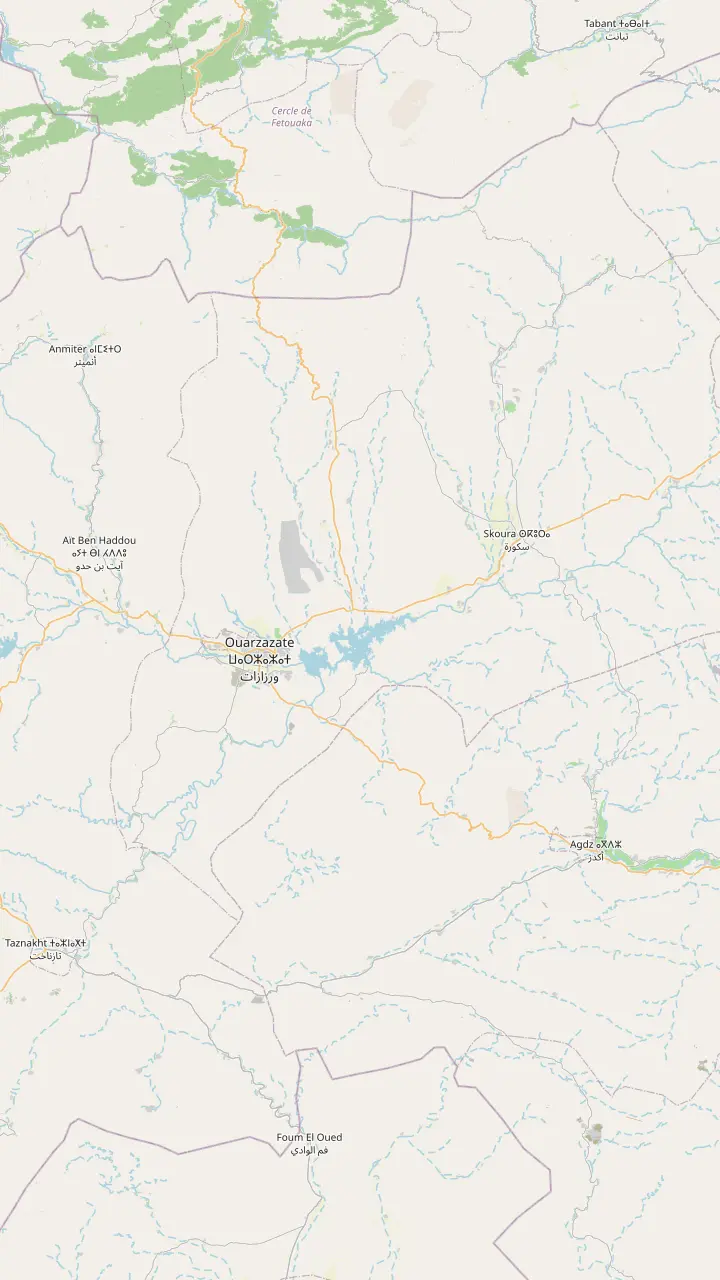
Ouarzazate is where the day turns round, and the tourism office puts Ait Benhaddou about 30 min and Skoura about 45 min from it.
Google MapsAtlas Studios is the film-studio stop, 80 minutes with a guided tour in the main listing of this site.
Google MapsTifoultoute is a kasbah near Ouarzazate that one listing starting from the town includes as a stop.
Google MapsFint oasis is one of the places the tourism office names for seeing the area around Ouarzazate with a guide.
Google MapsSkoura is named by the tourism office for its palm groves and sits about 45 min from Ouarzazate.
Google Maps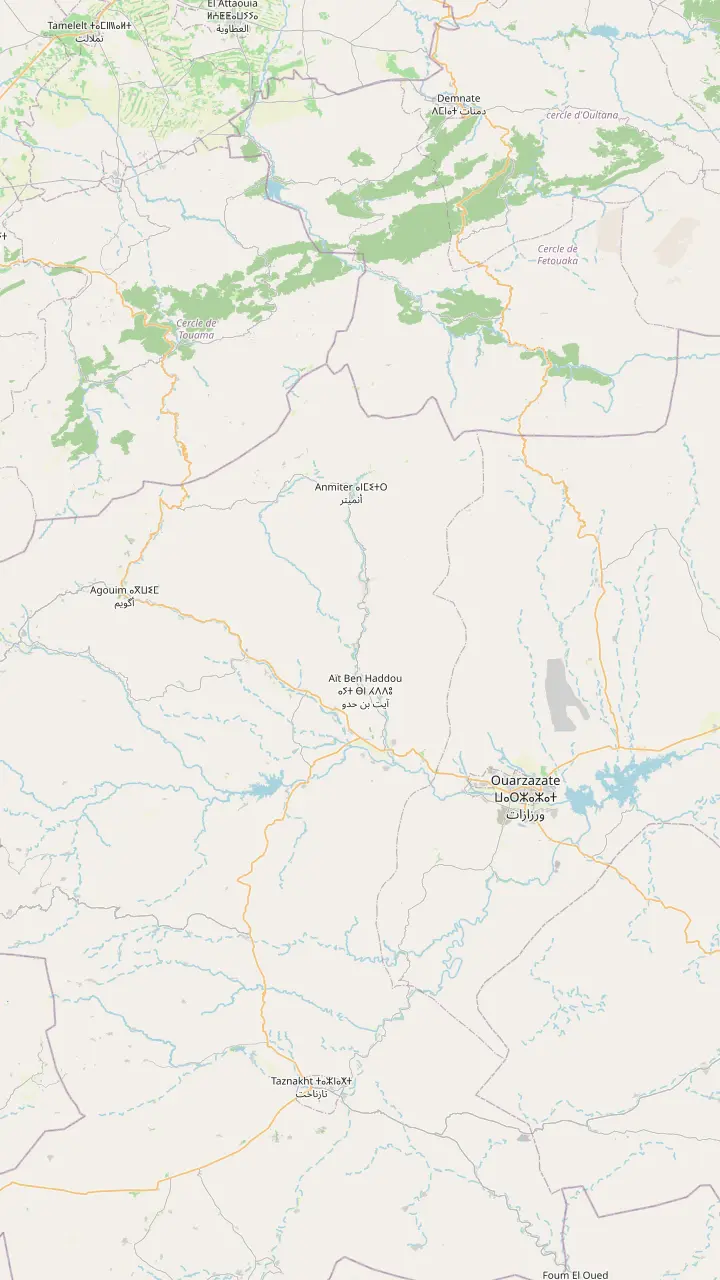
The ksar lies in the foothills on the southern slopes of the High Atlas, and UNESCO gives the inscribed property as 3.03 ha.
Google MapsTelouet is a mountain village in Ouarzazate province, drawn here so that the setting of the ksar below the pass reads on the map.
Google MapsThe Tizi n'Tichka viewpoint is a scenic stop of 15 to 25 minutes, depending on the listing.
Google MapsOuarzazate is where the day turns round, and the tourism office puts Ait Benhaddou about 30 min and Skoura about 45 min from it.
Google Maps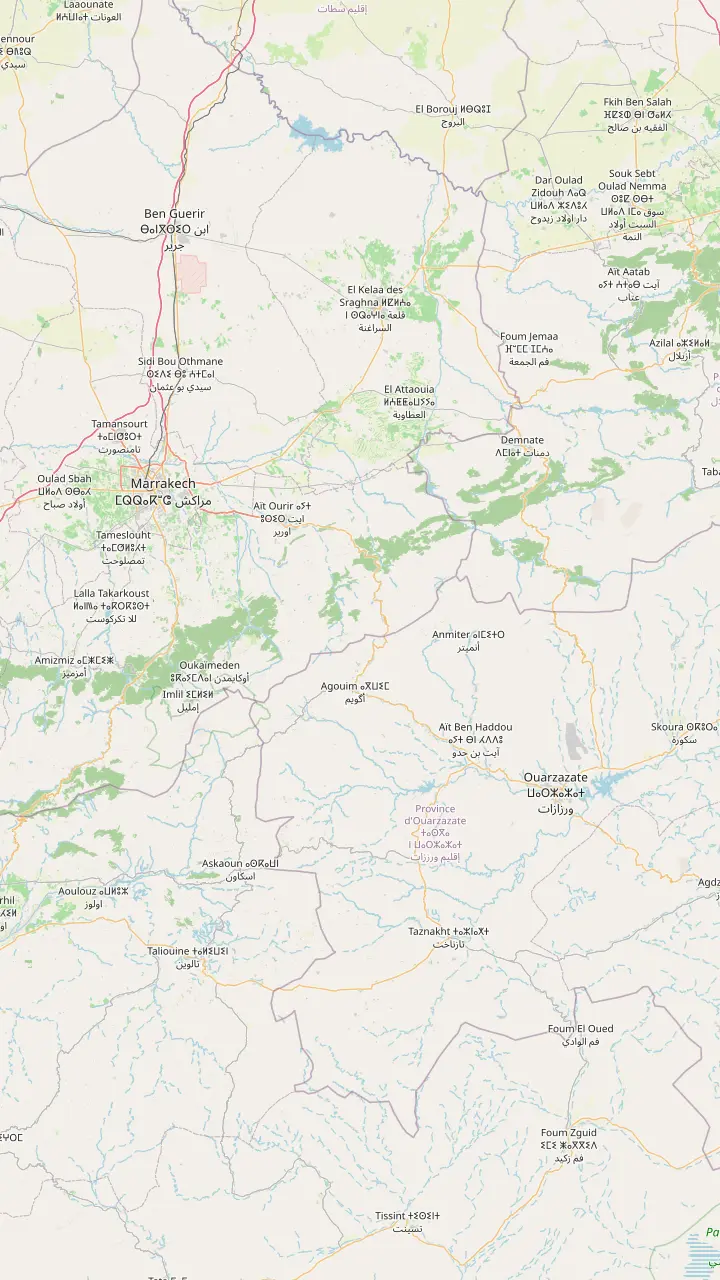
Marrakech is where every tour of this site begins, with a hotel pickup in the morning and the drop-off at night.
Google MapsAit Barka is a short stop on the climb, used by some listings for the first photos and a break.
Google MapsThe Tizi n'Tichka viewpoint is a scenic stop of 15 to 25 minutes, depending on the listing.
Google MapsThe ksar lies in the foothills on the southern slopes of the High Atlas, and UNESCO gives the inscribed property as 3.03 ha.
Google MapsAtlas Studios is the film-studio stop, 80 minutes with a guided tour in the main listing of this site.
Google MapsOuarzazate is where the day turns round, and the tourism office puts Ait Benhaddou about 30 min and Skoura about 45 min from it.
Google MapsBase map © OpenStreetMap contributors
What UNESCO says about the earthen ksar in the Ounila valley, how its walls and lanes work, what the film record of the Ouarzazate region adds and how long a day trip gives you there.
Editorial team, ouarzazatedaytrip.click · Updated November 23, 2026 · Read in 8 min
Summary view
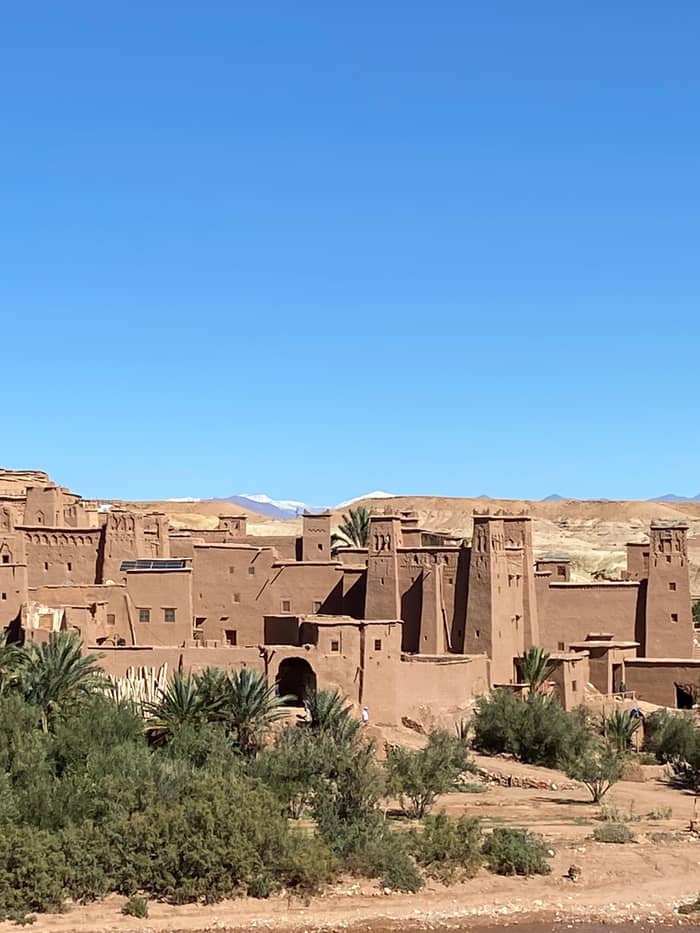
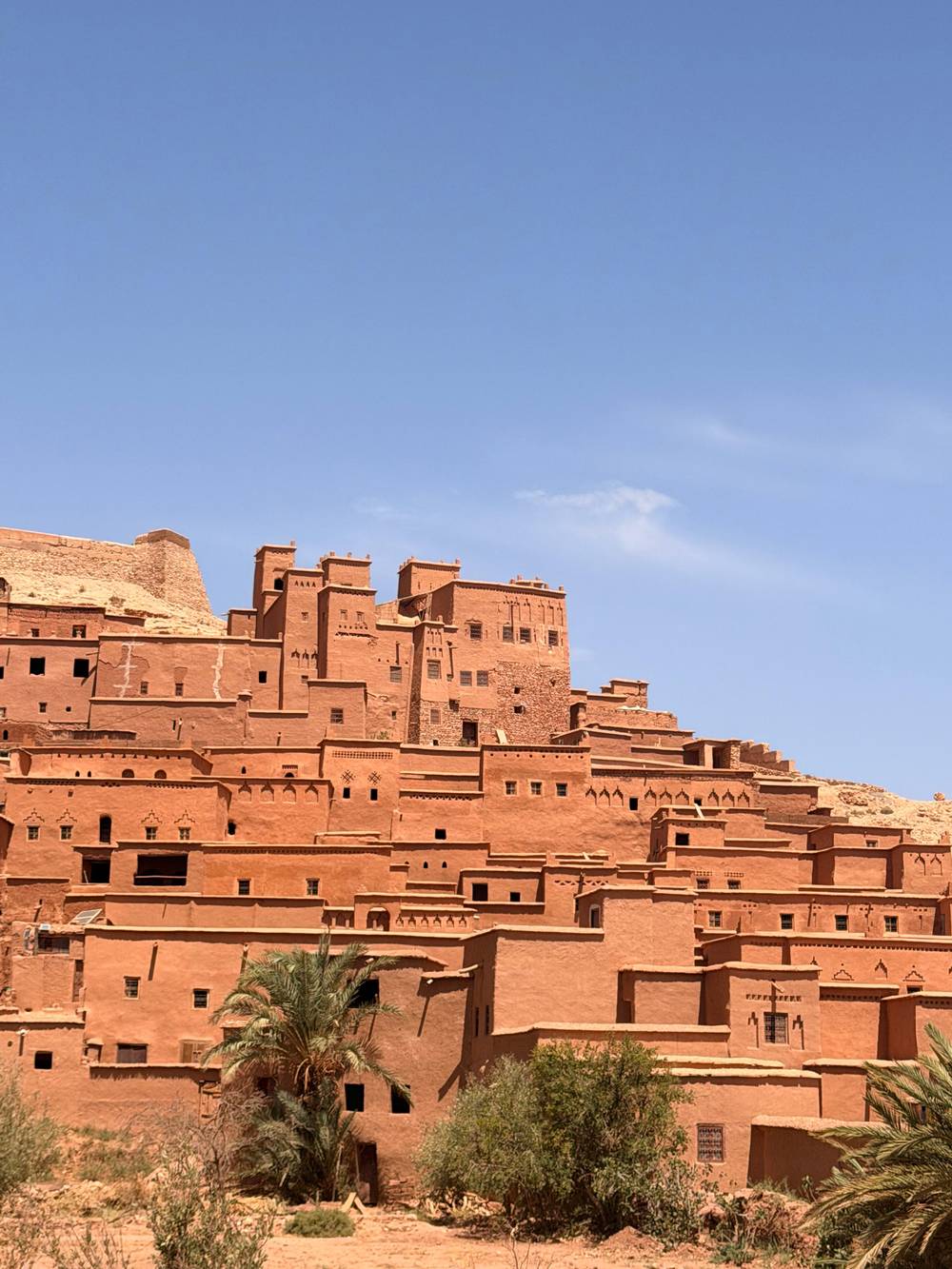
To visit Ait Ben Haddou is to walk into a village built entirely of earth. UNESCO calls it a traditional pre-Saharan habitat, earthen buildings gathered inside high walls, on the lower southern flank of the High Atlas in Ouarzazate province.5,2 Of all the ksars in the Ounila valley, it names this the most famous, and the claim is easy to believe once the red-brown towers come into view across a dry riverbed.2
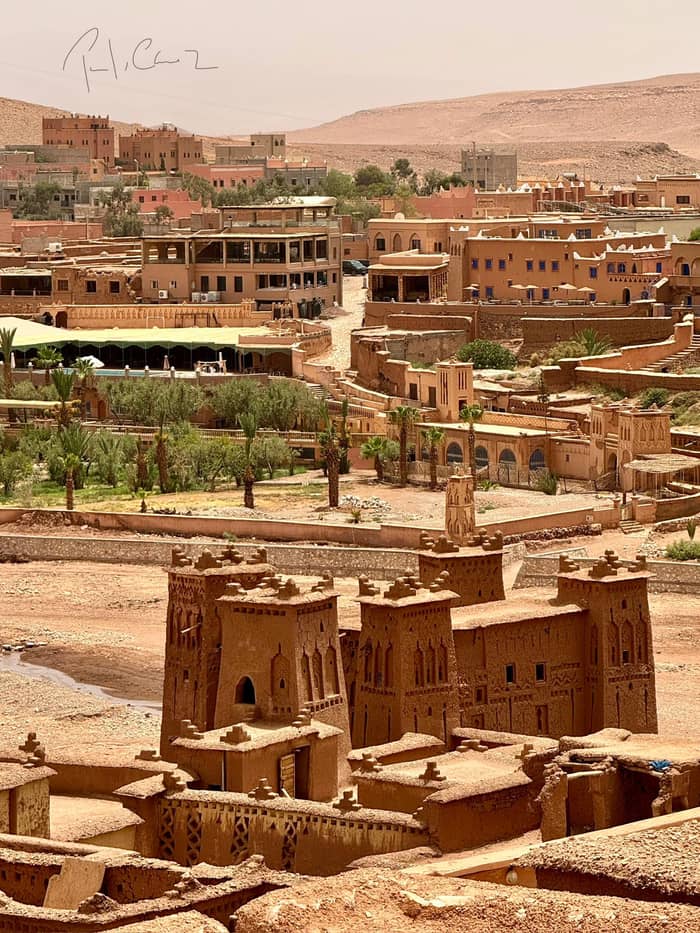
The word ksar means a fortified village, as opposed to a single kasbah, and the distinction explains much of what you see. The perimeter wall is strengthened with towers at its corners and entered through a gate built with a bend. Behind it the houses press close together, from plain family homes to tall corner-towered mansions whose upper parts carry patterns in clay brick.6 Streets are lanes rather than roads, and the whole settlement is meant to be read as a connected structure rather than a row of separate monuments.
UNESCO inscribed the property in 1987 under criteria (iv) and (v).1 UNESCO's judgement is that it stands out as a model of the southern Moroccan ksar, showing the main kinds of earthen construction.7 You do not need that vocabulary to enjoy a visit. What the inscription gives a traveller is the assurance that the place is documented and that an international body has judged it worth keeping.
The parts of the ksar
| Part | What UNESCO says | What to look for |
|---|---|---|
| Defensive walls | High walls with angle towers6 | The towers at the corners |
| Baffle gate | The walls are pierced with a baffle gate6 | The bent entrance |
| Houses | Some modest, some like small urban castles6 | Decorated upper sections |
| Public square | A community area of the ksar11 | Where the lanes open out |
| Loft and fortification | At the top of the village11 | The wide view of the valley |
| Mosque | Listed among the community areas11 | Quiet and modest dress |
| Caravanserai | Listed among the community areas12 | Where travelers once stopped |
| Cemeteries and sanctuary | Muslim and Jewish cemeteries and a saint's sanctuary12 | Keep to the paths |
The middle column restates UNESCO's list of the ksar's parts, and the right column is practical advice for a visitor.11
A ksar like this does not appear in empty country by chance. UNESCO counts Ait-Ben-Haddou among the staging posts on the old trade route between Marrakesh and what it calls ancient Sudan.8 Caravans carried goods across the Sahara and over the Atlas, and settlements along the way provided shelter, storage and a place to trade. Standing on the hill at the top of the village, you can see why the spot made sense: the valley below funnels travelers toward the mountain passes.
The buildings you see today are younger than the trade itself. UNESCO dates the oldest surviving structures no earlier than the 17th century, while pointing out that the way of building was already common in the valleys of southern Morocco long before.3 That sentence rewards a careful reading: it separates the age of the standing walls from the age of the way of building, and it explains why earthen villages along this region look alike without all being equally old.
The same inscription text lists the community areas that kept the village working. A caravanserai stood among them, as did a public square and grain threshing areas outside the ramparts, plus a fortified point and a storage loft at the crest of the village.11,12 Each of these shows a settlement that was never only a fortress. People stored harvests here, gathered here, prayed here and put up travelers here, and the layout you walk through is the record of that shared life.
Time at the ksar
The bars show the time each listing allots to the ksar, including lunch where the listing says so.
UNESCO states that the construction materials at Ait-Ben-Haddou are still earth and wood.14 That plain sentence is the heart of the place: clay walls, timber for the beams and door frames, and decoration worked into the clay brick of the upper sections.6 Earth is a patient material in a dry climate, and UNESCO calls the earthen constructions perfectly adapted to the climatic conditions and in harmony with the natural and social environment.15
Earth is also demanding. The same text warns of vulnerability: without regular maintenance and repair, which lapsed once inhabitants left the ksar, the earthen buildings are at risk.10 A wall that is not renewed after the winter rains weakens, and a roof that is not patched lets water in. When you see fresh clay on a wall or a repaired parapet, you are looking at the maintenance that keeps the whole village from slowly melting back into the valley.
Heritage managers watch for shortcuts. UNESCO notes particular attention to doors and windows that open on to the lanes, so that wood is not replaced by metal, and it adds that the heritage body CERKAS keeps watch, with difficulty, over how intact the property still looks.16,9 The phrase with difficulty is candid. It tells you that a living village under protection is a long negotiation, and that a few visible modern repairs are part of the story and not a sign of neglect by the people who guard it.
Pick your visit
Say what you want from the ksar and the fitting window appears.
If I want time to climb to the top
Take the longest window
The guided listing gives about 2.5 hours at the ksar.
If I want the studios in the same day
Take the main day trip
Its schedule includes 80 minutes inside Atlas Studios with a guide.
If I find long walks difficult
Read the listing note
The main listing says it is not recommended for difficulty walking at the kasbah.
If I want the ksar without a crowd
Add a night in the area
Visit Morocco advises setting aside 3 days for the region.13
If I only care about the history
Read UNESCO first
Its text covers the trade route, the 17th century and the earth walls.8,3,14
Compare the stop
Shortest window
A kasbah day trip
Visit and lunch
The main day trip
Longest window
A guided day trip
The ksar is more than a film set or a photo stop, and the inscription text says so. Among its community areas UNESCO lists a mosque, Muslim and Jewish cemeteries, and a shrine to the saint Sidi Ali or Amer.11,12 These are the places of a community with a religious life, and quiet manners and modest dress are the right response on the lanes.
Behave as a guest in someone's neighborhood. Ask first before pointing a camera at a resident or at a doorway that is plainly a family's home, walk on the lanes rather than climbing walls, and do not enter spaces that are closed. A shopkeeper who invites you into a craft stall expects a conversation, and you are free to say no politely. None of this needs an official rule; it follows from the plain fact that these are the community spaces of a real village.
UNESCO's note on abandonment is a reminder of how fragile that continuity is. The same text names the abandonment of the ksar by its inhabitants as the cause of the maintenance problem.10 Spend a little with the people who live and work in the village where you can, on tea, crafts or a meal, and carry your litter out.
Compare the tours
Add your travelers and see what each ksar day costs.
Side-by-side: 4 options
Add your travelers and see what each ksar day costs.
≈
View≈
View≈
View≈
ViewFigures are GetYourGuide from-prices, translated at the ECB reference rate. The booking step shows what you pay exactly.
The ksar through time
Early centuries
The method of building such villages was already spreading through the valleys of the south.3
Caravan trade
The ksar served as a staging post between Marrakesh and ancient Sudan.8
The standing walls
The oldest buildings that survive are no earlier than the 17th century.3
World Heritage listing
UNESCO listed the ksar in 1987 on criteria (iv) and (v).1
Today
CERKAS monitors the visual integrity of the property, with difficulty, and maintenance remains a challenge.9,10
Your visit
Tours give the ksar between 1.5 and 2.5 hours.
The film record belongs to the region first and to the ksar second. The Moroccan National Tourism Office says directors including David Lean, Ridley Scott, Martin Scorsese and Alejandro Gonzalez Inarritu chose the Ouarzazate area, and it lists Lawrence of Arabia and Gladiator alongside Kundun, Babel and Prison Break as titles shot in the region.19,20 That list is the safest statement a traveller can make about the cinema of the region, because it comes from the national tourism body.
Which scene was shot in which lane of the ksar is the kind of detail that guides tell with great confidence and official pages rarely record. This page therefore stops at what the tourism office says: the region is a film region, and the ksar sits in it, about 30 min from the town where the studios stand.4 When your guide points to a gate and names a film, enjoy the story, and treat the claim as the guide's own unless an official source states it.
A film connection is a reason to look at the ksar differently rather than a reason to rush. The same earth walls that serve as a backdrop were built for storage, defense and family life, and the light of early morning or late afternoon lights them best. If your Ait Ben Haddou trip also includes the studios in Ouarzazate, you will see the other side of the story, where sets are built for the camera and not for living in.
Video
The Roving Balys on YouTube · The video only starts loading on your tap.
The earthen buildings are very vulnerable due to lack of maintenance and regular repair resulting from the abandonment of the ksar by its inhabitants.
At the ksar
Day trips from Marrakech give the ksar a window that depends on the listing. The main listing of this site gives 2 hours at the ksar for the visit and lunch, a second listing gives about 2.5 hours with a guided walk and lunch, and a third gives 1.5 hours on its schedule. Another long-day listing says about 2 hours at the ksar with lunch. Read those times as the whole stop, not as time on your feet; across the whole day the stop itself is a modest share.
Lunch takes a share of that window. The main listing puts the visit and lunch together, which leaves whatever the meal does not use for lanes and viewpoints. If your priority is the climb to the top of the village, say so to the guide at the start and eat after, or choose the longer window. The listing also advises against the tour for anyone who struggles to walk the kasbah, and a person with limited mobility should read that line before booking.
The tourism office lists the ksar as a trip of about 30 min from Ouarzazate, and it advises setting aside 3 days for the whole region of Ouarzazate, Zagora and Tinghir.4,13 A day trip from Marrakech is therefore a sampler of that region, and a night in or near the ksar lets you see it outside the midday rush. We sell no hotels; the point is that the ksar rewards the traveller who is there before the tour buses arrive and after they leave.
People searching for where Ait Ben Haddou is want a short answer, and UNESCO's is Ouarzazate province, the southern foothills of the High Atlas, the Ounila valley.2 On a map of the road from Marrakech it sits beyond the mountain pass and before the town of Ouarzazate. The map above marks the ksar with the pass, the town and the neighboring valley.
Anyone looking at where to stay in Ait Ben Haddou is choosing between sleeping near the ksar and sleeping in Ouarzazate, which the tourism office puts about 30 min away.4 A night near the ksar lets you walk it after the day groups have left, and it adds a morning to the visit. Check the official tourism pages and the properties themselves for current details; this site sells tours and not rooms.
For a short extension, the tourism office names Skoura, with its palm groves, about 45 min from Ouarzazate, and the oasis of Fint among the places to see with a guide.4,18 Dades is about 2 hr from Ouarzazate and Zagora about 4 hr.4 For an Ait Ben Haddou trip that stretches beyond a day, those longer distances show why a night or a couple of nights in the region suits anyone who wants more than the ksar.
FAQ
The ksar joined the World Heritage List in 1987 on criteria (iv) and (v).1
UNESCO dates the oldest standing constructions to no earlier than the 17th century.3
UNESCO says earth and wood are still the building materials.14
The national tourism body lists those titles, plus Kundun, Babel and Prison Break.20
Listings give 1.5 hours, about 2 hours or about 2.5 hours at the ksar.
The main listing advises against the tour for anyone who struggles to walk the kasbah.
The tourism office lists the ksar as a trip of about 30 min from Ouarzazate.4
Sources
Continue reading
Planning the ksar and the studios in a day? Ask a real person here.